
Which vacuum table is right for you?
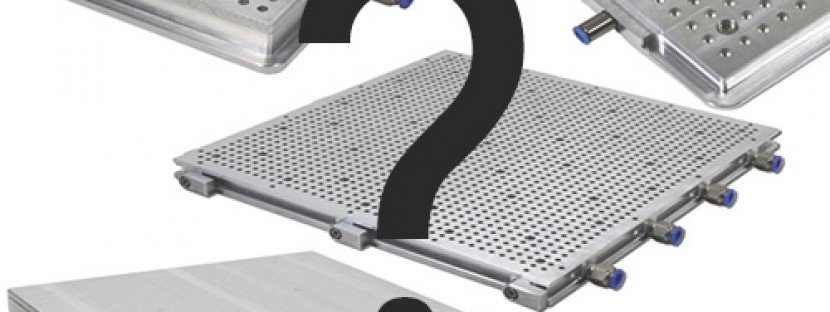
With a wide selection of vacuum tables available, selecting the correct solution for your application can seem complex.
In practice, most vacuum tables fall into two primary categories: Grid (Raster) and Hole Grid (Matrix). Understanding the differences between these systems will help you determine which is best suited to your machining requirements.
Grid / Raster Tables
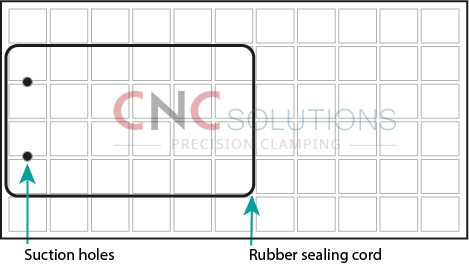
Grid vacuum tables are typically a cost-effective solution due to their lower vacuum demand. A compressed-air generator such as a Venturi system, paired with a compressor—or even a domestic vacuum cleaner—can often provide sufficient suction.
Rubber sealing cord is positioned within the grid channels to create a defined vacuum zone around the workpiece. With the part placed directly onto the table surface, high machining accuracy can be achieved. For smaller components, an adapter or sacrificial mat can improve stability during machining.
Break-through milling of smaller parts is possible using a PVC sacrificial mat placed between the workpiece and the table surface. For example, if machining a circular part with a diameter of 100 mm, a 90 mm cut-out in the PVC mat would maintain sufficient sealing area while allowing through-cutting.
Once configured, grid tables are well suited to batch production of repeat parts. However, setup time can increase when machining frequently changing geometries due to reconfiguring seals and sacrificial layers.
Our Grid / Raster Series
| R Series | Suitable for woodworking and light metal applications. |
| RAL Series | Narrower grid design with integrated workpiece stops and threaded surface grid. |
| RAL Pro Series | Advanced RAL development with integrated Venturi vacuum generator and steel thread grid. |
| All-in-One Kits | Complete R and RAL system packages providing exceptional value and rapid setup. |
Hole Grid / Matrix Tables
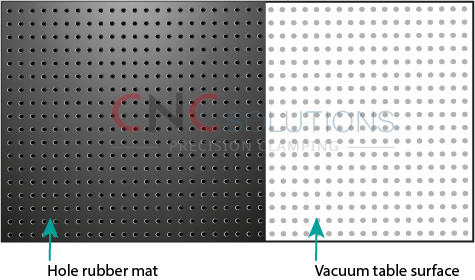
Hole grid tables feature a matrix of precision-drilled holes across the table surface. Combined with a perforated rubber mat, this system allows quick positioning and repositioning of workpieces while enabling through-milling in a single operation.
The rubber mat acts as a sacrificial layer, protecting the table surface when cutting through by approximately 0.2 mm. This makes the system highly efficient for production environments requiring flexibility.
Because of increased airflow, hole grid systems typically require vacuum sources with higher differential pressure. Dry-running rotary vane pumps are a common choice due to their strong flow rate and low maintenance requirements.
For large or semi-porous materials where air leakage may be significant, a side channel blower is recommended. When machining metals with coolant, a liquid ring pump is often preferred as it continuously recirculates coolant while separating swarf.
Our Hole Grid / Matrix Series
| ST Series | Entry-level solution ideal for wood and plastic machining. |
| SEAL Series | Enhanced rigidity with aluminium base plate; suitable for light metal work. |
| GAL Series | 100% cast aluminium construction with switchable vacuum zones; excellent vibration absorption for heavy metal machining. |
| GR Series | Flagship system combining GAL performance with steel thread bushings and integrated workpiece stops. |